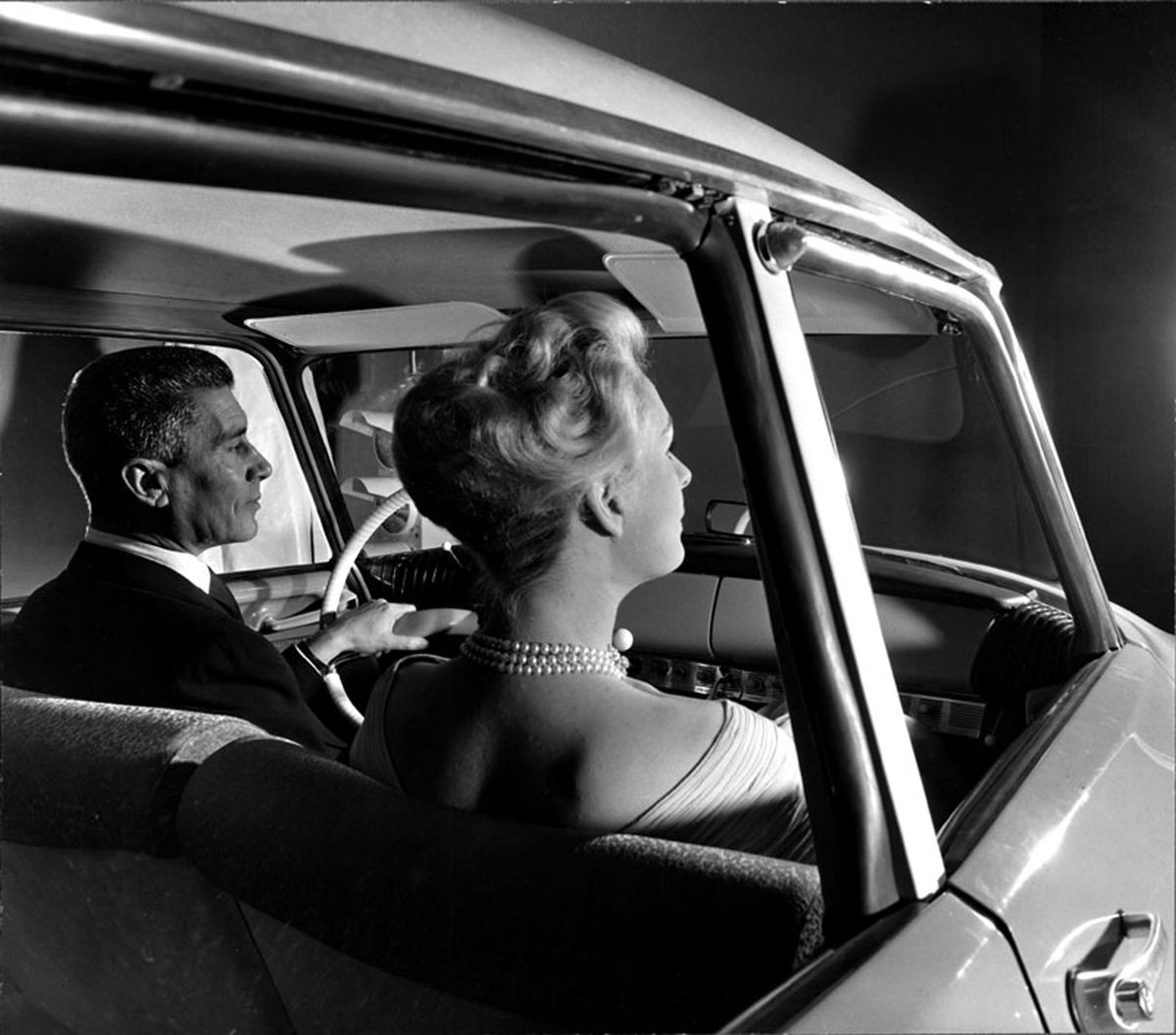
The ID19, perfect in its simplicity, was presented to the public at the 43rd Paris Motor Show on October 6, 1956. To name the new model, as with the DS, Citroën turned to an acronym with a clever double meaning in French: ID, short for Idée (“Idea”). The ID19 was launched in three versions: Luxe, Normale, and Confort and, of course, it was offered at prices lower than those of the DS19. While the price of a Dea was 1,065,000 francs at the time, the ID Normale (which did not arrive until December 1957) cost 894,000. However, the ID Luxe cost 925,000, rising to 967,000 for the ID Confort, whose equipment was similar to that of the DS.
The three ID models differed from the DS19 in several key ways.
Mechanically, the ID lacked power steering, power-assisted brakes, and the semi-automatic transmission of the DS, relying instead on conventional controls and a standard four-speed manual gearbox, with the top three gears synchronized. Visually, the differences were also clear. The ID featured a plain fiberglass roof, aluminum bumpers, painted sheet-metal side panels and headlight surrounds, simpler rear reflectors, wheel caps replaced by simple center bolt covers. It also lacked the decorative side along the metal struts and the boot lid was held open by a simple rod instead of compensating springs. Inside, the cost-cutting was equally evident: there was no soft Dunlopillo padding beneath the carpets, door handles were plastic rather than chrome, and a straightforward horizontal plastic dashboard replaced the elegant “wave” dashboard of the DS19. Despite these simplifications, the ID proved to be an immediate and convincing success to the point that Citroën finally ceased production of the long-running Traction Avant, which had continued in parallel with the DS.