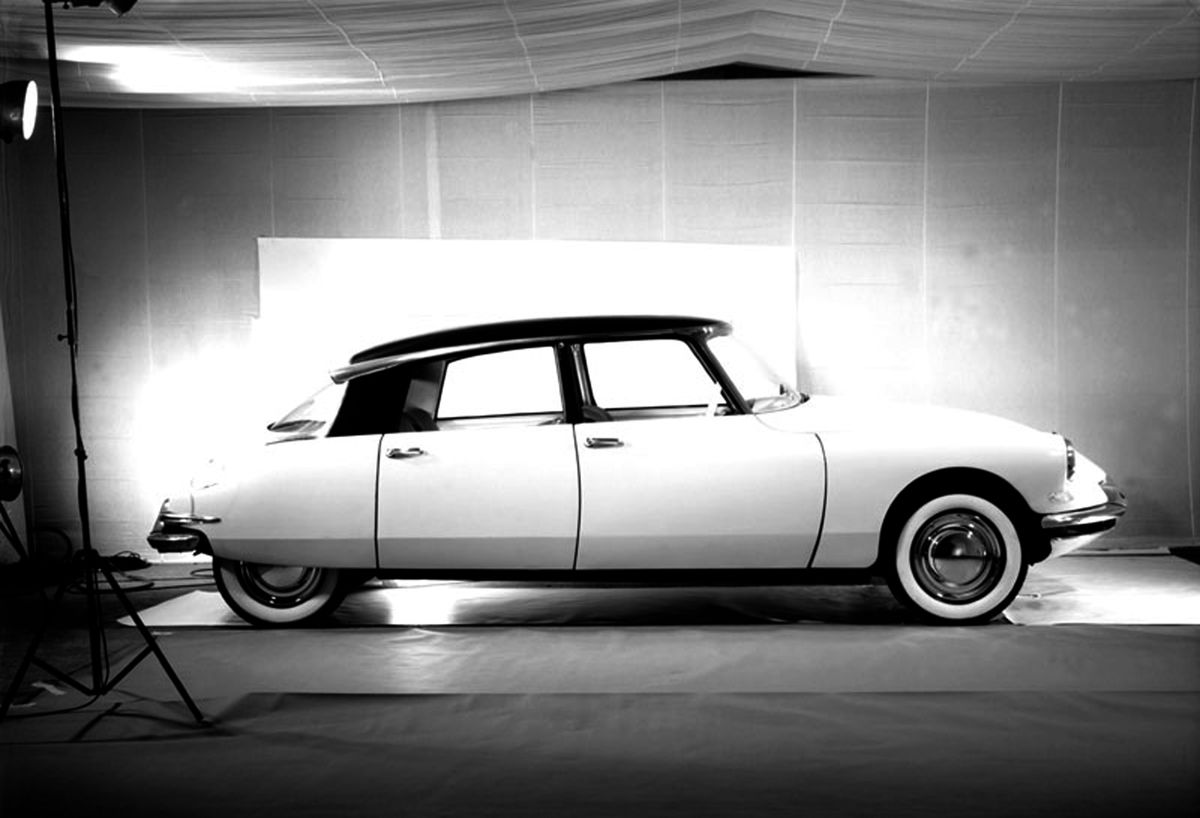
“I want a car with large glass surfaces: visibility is safety” asked André Lefebvre to the Italian designer Flaminio Bertoni. With these words, Lefebvre, engineer and head of the project that would lead to the creation of the DS19, meant to model a car that offered its occupants a panoramic view of the surrounding space.
Bertoni gladly accepted the challenge. The artist from Varese considered himself more a sculptor than a designer, and so he began shaping the future DS in large blocks of plasticine. Over the long years of development—work began in 1938, and the car was unveiled in 1955—Bertoni’s hands smoothed every edge of the clay model until the only flat surfaces left were those of the side windows. The DS19 became a symphony of curves, seamlessly connected, giving the nearly five-metre-long silhouette the ability to slip through the air without disturbing its flow. And the glass? As the Italian brochure proudly declared: “With 2.25 square metres of glass around you, you are the European driver with the best view”.
And it was entirely true: Bertoni insisted on a panoramic, sloping, wraparound windscreen, and the same treatment for the rear window. That glass was impossible to produce with the technology of the time. Yet, the determined Italian designer managed to achieve it, thanks to the support of engineer André Lefebvre, who recognized curved glass as an excellent aerodynamic solution, and to the commitment of Saint-Gobain, a leader in automotive glass production then as now.
The rear window required a few more years of development. On the earliest ID and DS models, it was made of Plexiglas, the only material available at the time that offered both durability and transparency comparable to glass. Remarkably, many of those first DS cars are still on the road today.